Showing posts with label floral stencil. Show all posts

Friday, July 29, 2016

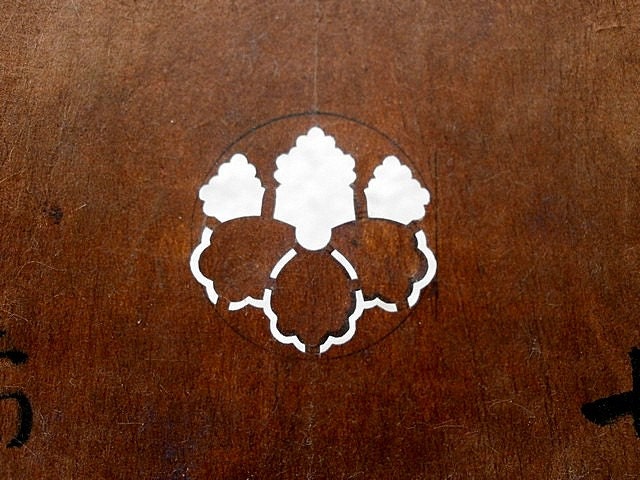
Vintage Japanese Stencil - Traditional Japanese Stencil - Family Crest - Flower

Vintage Japanese Stencil - Traditional Japanese Stencil - Family Crest - Flower


Vintage Japanese Stencil - Traditional Japanese Stencil - Family Crest - Flower


This was an amazing find. They are from the "昭和" "showa period" . The "showa" period is from 1926-1989 but these are at about 25-30 years old . This is called "型紙" or "katagami". This is a stencil that was used to make "kashigata" (for more information on "kashigata please see below).

This is really gorgeous! The shape is that of a "kamon" which means a family crest (which crest we don't know). There are no set rules in the design of a kamon. It most commonly consists of a roundel encircling a figure of plant, animal, man-made, natural or celestial objects, all abstracted to various degrees. Religious symbols, geometric shapes and kanji were commonly used as well. These symbols are often found in logos of stores (which help to identify what they sell), sushi restaurants, and on packages of food to lend an air of elegance. Senbei (Japanese crackers) and other traditional Japanese sweets may also use one.


The stencil measures about 7.8 x 6.5 cm.

More information on "kashigata" (the sweets made from the molds that were made using the stencils).

In the past, when a person died, it was expensive to give flowers or fresh food so, people made sweets (these are made from soy flour, rice flour and sugar) in the form of flowers, fish etc. These items were then placed on the "butsudan" (family shrine found in the house) for the dead person.

The sweets was also used for holiday celebrations, tea ceremony etc. These are for decoration only-they are never eaten.


To see more stencils please click here
http://www.etsy.com/shop/VintageFromJapan?section_id=6263764


**********************************************************
Our Etsy Stores:


For handmade & cute food rings, earrings, pendants and other jewelry / accessory http://souzoucreations.etsy.com

For wholesale prices on cabochons, clay canes and morehttp://decosweets.etsy.com

For Japanese vintage goods http://vintagefromjapan.etsy.com

For Japanese stickers, fabric, and more http://fromjapanwithlove.etsy.com

Wednesday, April 2, 2014

Katagami Stencil From Japan


This was an amazing find. They are from the "昭和" "showa period" . The "showa" period is from 1926-1989 but these are at about 25-30 years old . This is called "型紙" or "katagami". This is a stencil that was used to make "kashigata" (for more information on "kashigata please see below).

This is really gorgeous! The shape is that of a "kamon" which means a family crest (which crest we don't know). There are no set rules in the design of a kamon. It most commonly consists of a roundel encircling a figure of plant, animal, man-made, natural or celestial objects, all abstracted to various degrees. Religious symbols, geometric shapes and kanji were commonly used as well. These symbols are often found in logos of stores (which help to identify what they sell), sushi restaurants, and on packages of food to lend an air of elegance. Senbei (Japanese crackers) and other traditional Japanese sweets may also use one.

For more of our vintage stencils please click here
http://www.etsy.com/shop/VintageFromJapan?section_id=6263764

Thursday, June 7, 2012

Vintage Japanese Stencil Flowers Leaves Kimono Katagami in Showa Period

Media_httpimg1ecetsys_nfhqm

Vintage Japanese Stencil Flowers Leaves Kimono Katagami in Showa Period http://www.etsy.com/listing/92268437/vintage-japanese-stencil-flowers-leaves

This was an amazing find. This is called "型紙" or "katagami" stencil. This is a stencil that was used to make "kashigata" (for more information on "kashigata please see below).

They are from the "昭和" "showa period" . The "showa" period is from 1926-1989 but these are at about 25-30 years old .

Katagami are made of multiple layers of thin mulberry paper which are bonded with a glue extracted from persimmon, which makes a strong flexible brown coloured paper.

This katagami was used for "katazome" which is the method of dyeing fabrics (kimonos) using a stencil and a resist paste. The resist paste was made with rice flour and when dyed, the dye didn't adhere to the areas covered with the paste. It was an inexpensive way to make all-over patterns similar to a woven cloth.

Wednesday, May 23, 2012

Vintage Japanese Stencil Family Crest Kamon Stencil C9 by VintageFromJapan on Etsy

Media_httpimg0ecetsys_jdnbf

Vintage Japanese Stencil Family Crest Kamon Stencil C9 by VintageFromJapan on Etsy http://www.etsy.com/listing/100242379/vintage-japanese-stencil-family-crest

This was an amazing find. They are from the "昭和" "showa period" . The "showa" period is from 1926-1989 but these are at about 25-30 years old . This is called "型紙" or "katagami". This is a stencil that was used to make "kashigata" (for more information on "kashigata please see below).

This is really gorgeous! The shape is that of a "kamon" which means a family crest (which crest we don't know). There are no set rules in the design of a kamon. It most commonly consists of a roundel encircling a figure of plant, animal, man-made, natural or celestial objects, all abstracted to various degrees. Religious symbols, geometric shapes and kanji were commonly used as well. These symbols are often found in logos of stores (which help to identify what they sell), sushi restaurants, and on packages of food to lend an air of elegance. Senbei (Japanese crackers) and other traditional Japanese sweets may also use one.

LinkWithin

Related Posts with Thumbnails